

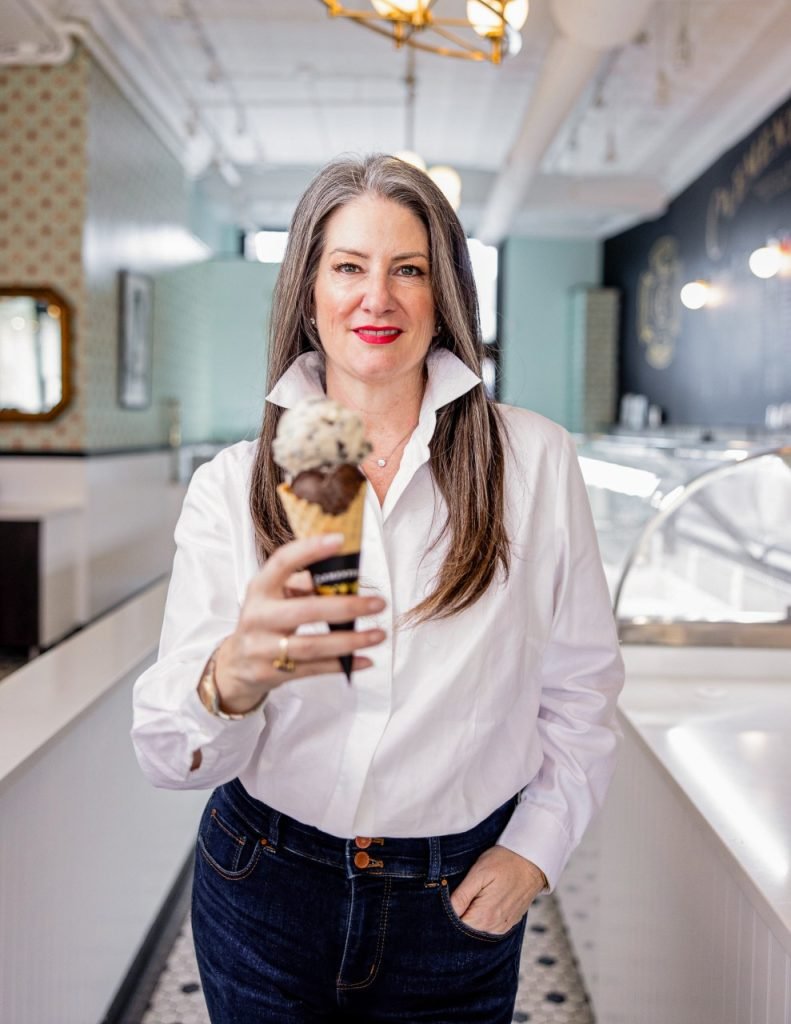
Before Tamara Keefe opened her first ice cream parlor, she was driving around St. Louis delivering pints herself. She had already started selling to restaurants, but without a storefront, she needed another way to bring in revenue. Her offer was simple: order her ice cream, and she would deliver it anywhere in the city for free. In November 2014, she recalls delivering more than 1,100 pints. That December, the figure reached approximately 1,500. She also knocked on doors in her neighborhood, offering to provide free dessert for Christmas parties if the hosts would let her leave an order sheet. By January, she was exhausted. “I got to get a parlor opened,” she remembers thinking. The demand for what would become Clementine’s Ice Cream was taking shape before customers had a counter to visit.
For Keefe, ice cream had long been connected to the experience of being welcomed somewhere. Growing up in a large Irish-Italian household with four brothers and her grandparents, she watched other children leave church for ice cream outings her family could not afford. Then her mother found a $2 hand-crank ice cream maker at a garage sale, and Sunday afternoons changed. The family began making ice cream at home, and eventually other church families asked to join them. Because the Keefes could not afford to supply everyone, visitors contributed ingredients: milk, cream, fruit. A family that had often felt outside the social circle became a gathering point. “My whole sense of community changed as a child because of an ice cream cone,” Keefe says. That memory would eventually become the foundation of her business.
Her route to entrepreneurship, however, ran through roughly two decades in corporate America. Keefe worked in marketing and brand strategy, eventually taking responsibility for a $70 million business. Her career also exposed her to the ingredient side of the food industry, where she learned about manufacturing, food safety, sensory science, and scaling production, before moving into consumer packaged goods. Those experiences gave her a practical understanding of both how food is made and how consumers decide to buy it. “Everything I did in my career led me to the place where I could go start my own ice cream company,” she says. What began as the idea of opening a scoop shop drew on a much broader set of skills.
Those skills did not eliminate the financial risk. About six months into building the business in 2014, Keefe says she ran out of money. She had no family capital to draw on and little operating history to persuade a bank to lend. To finish launching, she cashed out her 401(k). “I decided to take the biggest bet of my life and bet on myself,” she says. With her money committed, customer acquisition became immediate, personal work. She walked into leading St. Louis restaurants during the afternoon and asked chefs to try her ice cream. Restaurant orders and appearances on menus helped introduce her name to diners, while neighborhood deliveries and holiday parties gave those customers a way to buy directly.
The product she was selling reflected deliberate production choices. Clementine’s makes small batches, prepares its own mix-ins or collaborates with other makers, and uses a dairy base with 16% to 18% butterfat. Keefe says the company keeps overrun, the amount of air incorporated during freezing, below 30%, producing a dense texture. Cookies, cakes, caramel, and candied nuts are part of the work behind the finished scoop. The menu extends from Gooey Butter Cake to non-dairy options and the brand’s alcohol-infused “Naughty” flavors, which use a proprietary process developed with food scientists and chemists. Her approach to flavor also draws on years of international travel and an interest in serving customers whose tastes may receive less attention in conventional ice cream menus.
Keefe applies the same attention to the parlors themselves. She describes an experience shaped by tasting and conversation, music, materials, and the way employees treat customers. The goal is for people to remember how a visit felt alongside what they ordered. That combination has helped Clementine’s reach customers well beyond its Midwestern stores. In the interview, Keefe said the business ships thousands of packages annually through Goldbelly, with New York City and Los Angeles its two largest shipping markets. For a company that began with its founder delivering pints around St. Louis, those orders offer a concrete measure of how far its audience now extends.
The next stage brings a different challenge. In March 2026, Clementine’s announced a $6 million funding round led by Next Phase Capital to support expansion, including franchising. It also entered grocery stores through a partnership with Schnucks. Centralized production gives Keefe control over the ice cream, and design standards can guide how new parlors look. Hospitality is harder to reproduce. She says choosing franchisees who respect the brand and care about the customer experience matters more than selling as many franchises as possible. “It’s how you treat people and how they feel,” she says. As Clementine’s grows, that is the part of the business she is most focused on preserving: the sense of welcome she first discovered when neighbors began arriving at her family’s home with ingredients for Sunday ice cream.
